For the past 25 years, digital marketing has taught us a pretty simple lesson…
If you can’t get the visibility you want organically, just pay for it.
Can’t rank high enough on Google? Buy the keyword. Organic reach on social disappears? Boost the post. Want to reach someone watching television without dropping a fortune on network TV? Buy streaming.
Oh, and if you need to find the right person at precisely the right moment? There’s programmatic, contextual targeting, retargeting, PPC, and about 147 other acronyms a media agency would be happy to put on a media plan.
That’s a best case scenario. Too often, organizations have simply ignored organic altogether because paid felt faster and easier to measure.
And now we have generative AI and an entirely new visibility problem: how do you build AI visibility when people are increasingly asking ChatGPT, Gemini, Perplexity, and Google for the answer instead of simply searching for a link?
So naturally, marketers are starting to ask some version of the same question: How much does it cost to get into the answer?
Except that’s the wrong question.
You can absolutely buy advertising around an AI conversation. OpenAI is already expanding ChatGPT Ads, positioning them as a way for brands to reach people as they explore choices, compare alternatives, and make decisions.
But even OpenAI acknowledges a problem with the traditional paid over organic thinking. They say that advertising does not influence ChatGPT’s answers, and ads remain separate from the organic response.
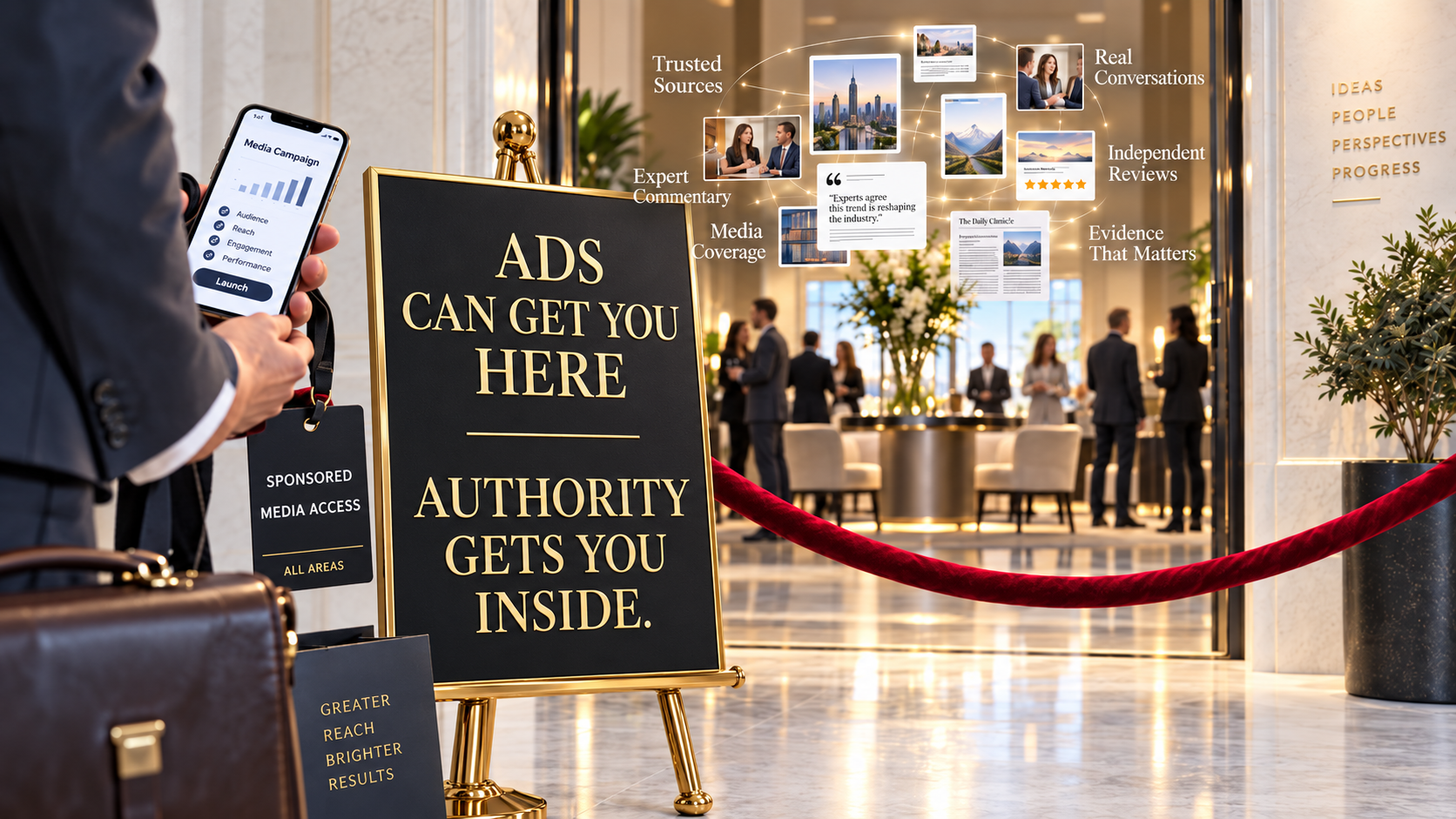
What they are saying is that you can buy proximity to relevance, but you can’t buy relevance itself.
That distinction has some pretty significant implications for how marketing and communications teams think about paid, earned, shared, and owned media.
Search ads changed marketing because, for one of the first times, we didn’t have to simply interrupt people and hope they cared.
What a moment! We could meet them when they were already looking for something.
Someone types “best accounting software for small business” into Google, and suddenly you know quite a bit. You know there is a need, what they are interested in, and that they are comparing options. You might even have some idea how close they are to making a decision.
Intent became visible, and that made paid search incredibly valuable because marketers could buy access to demand at almost the exact moment someone expressed it.
Then we got better at it. Paid search expanded into display advertising, social platforms, programmatic media, streaming, retail media, and increasingly sophisticated contextual and audience targeting.
The tools changed, the data got better, and the targeting got more precise. At the time I was blown away by what we could do.
But the basic equation stayed fairly consistent.
Find the audience, understand what they want, pay for access to them, and give them something to do next. There’s nothing inherently wrong with that equation. It worked extraordinarily well, and it still does.
Paid media solved a real business problem: How do I get the right message in front of the right person at the right time
The mistake would be assuming generative AI is simply the next place where we can apply the exact same formula, because something fundamental has changed.
The person on the other side isn’t just searching anymore; they’re having a conversation.
Until recently, digital search had a fairly predictable rhythm.
You typed a question, Google returned a page of results, you clicked one, and then you evaluated what you found.
But, Google itself—to say nothing of the AI platforms—has been rebuilding search around more conversational behavior. Its AI experiences allow people to ask follow-up questions from an initial result while carrying the context of the original question forward. All of that has led to people using AI-powered search for deeper and more complex questions.
ChatGPT takes that behavior even further. You may still search Google for “best PR agency Chicago,” but in a generative platform, you can say:
“I run a $500 million healthcare company and need a communications agency that understands reputation, crisis, executive positioning, and AI search. Who should I look at?”
It doesn’t end there. Then you can keep going and perhaps ask:
“Which of those firms has experience with regulated industries?”
“Which ones have the strongest crisis communications experience?”
“I’d like you to compare the top three choices.”
“What should I ask them during an RFP?”
Do you see what’s happening? We’re doing something different, because we aren’t simply searching for information. We’re adding context, challenging answers, narrowing choices, and asking the system to help us make sense of what it finds.
And once search becomes a conversation, relevance becomes more complicated than simply showing up on the screen.
The system doesn’t just need to find you; it needs the trust signals to believe you belong in the conversation.
Traditional search (is that really a thing now?!) has spent decades trying to answer a variation of the question: Which page should rank for what this person is searching for?
Generative AI has a different problem, which is basically, “What information should I use to construct an answer?”
They may be similar, but they’re not the same thing.
A company can buy an ad alongside an AI conversation. That means it can pay for exposure to someone who happens to be discussing something relevant to that business.
But buying that space does not mean the advertiser becomes part of the organic answer. OpenAI is explicit about that separation, saying advertisers cannot pay to influence, rank, or alter ChatGPT’s responses.
That means the answer needs evidence of its own, which we know primarily comes from authoritative owned content and third-party coverage and citations.
It’s true that not every LLM evaluates information exactly the same way, and none of us should pretend there is a magical checklist that guarantees inclusion.
But the broader point is that there has to be enough credible evidence to support the idea that you know something, do something, or deserve to be included in a particular conversation.
Paid can provide exposure, but it can’t create authority. Authority has to be built somewhere else, and increasingly, it needs to be built systematically.
There has been a push lately to lump a lot of that evidence together under a new label: unpaid media.
I understand the temptation, but I hate it!
From the perspective of generative AI discovery, an AI system can encounter information from your website, a journalist’s article, a Reddit discussion, a LinkedIn post, an analyst report, a customer review, or a podcast transcript, among many other places.
Marketers and communicators want to neatly sort those things into earned, shared, and owned media, but the machine sees evidence.
So, sure, there is some usefulness in distinguishing all of that from paid media, but “unpaid media?” Let’s just stop for a second and think.
We’re taking three incredibly important communications disciplines and defining them by the thing they aren’t. As part of my crisis background, some of the advice I always give is to talk about what you ARE vs. what you AREN’T!
It also obscures an important strategic difference between them. Owned media establishes what you know, and it gives you the space to explain your expertise, ideas, products, services, and point of view.
Earned media provides independent validation when someone else says you know what you’re talking about. Shared media creates conversation when people react to ideas, discuss them, challenge them, recommend them, and carry them into their own communities.
Paid media does something different; it accelerates distribution and helps move audiences toward an action. Did you notice I’m not saying that paid media buys you relevance with an audience?
The distinction matters because generative AI relevance doesn’t come from simply accumulating a pile of “unpaid” mentions. It comes from getting the different parts of the media ecosystem to reinforce one another.
Which, as it turns out, is not exactly a new idea.
Gini Dietrich created the PESO Model long before anyone was worrying about whether ChatGPT might mention their company in an answer.
But generative discovery makes the logic behind the PESO Model even more important.
For years, organizations have treated paid media as the primary marketing and communications strategy, while everything else became support.
Create the campaign, build the media plan, buy the reach, and then add some PR, produce some content, and put a few things on social media. Generative AI turns that thinking upside down because those other channels help build the authority paid media can’t simply purchase.
Owned media builds the knowledge base, earned media adds third-party validation, and shared media creates conversation, reaction, advocacy, and community.
Then paid media amplifies the right messages, expands reach, and creates opportunities for action.
None of those channels replaces the others. Instead, they compound.
A strong owned resource may generate earned coverage. Earned coverage creates something worth sharing. Shared conversations reveal new questions audiences are asking. Paid media can then amplify the strongest ideas or put a relevant offer in front of someone at precisely the right moment.
That is an ecosystem that’s giving signals to generative AI platforms that you should be included.
Let’s pause for a minute, because this is not an argument that paid media suddenly doesn’t matter. In fact, it’s the opposite.
OpenAI is continuing to build out its advertising platform, including self-service buying, CPC bidding, conversion optimization, audience targeting, and additional measurement capabilities. Advertising opportunities will only grow with ChatGPT and similar platforms.
How could it not? Imagine being able to reach someone while they are actively researching an expensive purchase, evaluating potential vendors, or trying to solve a complicated business problem.
Paid media can introduce someone to a brand they hadn’t considered, reinforce an existing message, capture demand, create demand, reach people demonstrating intent, and move someone toward a conversion. Just like it was able to do with that “traditional search.”
But paid media has become less capable of doing the whole job by itself. It can’t simply purchase the underlying authority that causes an independent AI response to include your organization as an expert, source, or recommendation.
All of that has to exist before the ad ever shows up, which means the organizations most likely to benefit from AI advertising may ultimately be the ones doing the strongest work everywhere else, too.
They are the ones who have something worth amplifying. Their content answers real questions, third parties validate their expertise, their positioning is clear, and their reputation supports the claims they make.
The ad helps accelerate something that already exists; it doesn’t create it from scratch.
The Search Engine Journal article that originally sent me down this rabbit hole makes an important point:
Marketers shouldn’t automatically move money from paid search into ChatGPT Ads simply because both channels happen to involve people looking for information.
They aren’t the same experience.
People using ChatGPT are often having longer conversations, asking follow-up questions, researching possibilities and working their way through decisions. The signals, behaviors, and measurement expectations are different from a traditional keyword-driven search campaign.
I’d take that argument one step further. Marketers also shouldn’t assume buying ChatGPT advertising solves their AI visibility problem, because these are two completely different strategic questions.
ChatGPT advertising asks: How do I reach someone during this conversation?
Generative AI visibility asks: How do I become credible enough to influence the organic answer to the conversation?
One is media buying, while the other is reputation, authority, content, discoverability, and communications. What Gini Dietrich calls Visibility Engineering™.
That distinction matters because if organizations collapse the two ideas into one bucket called “AI marketing,” they’ll spend money trying to solve a problem money alone can’t solve.
We have a habit in marketing of starting with the media question.
Where should we spend the budget? Google, LinkedIn, Meta, streaming, programmatic, and now ChatGPT?
I’ll pose this question—what if that’s the wrong place to start?
Start instead with: What are we trying to make true in the mind of the audience?
That’s when the conversation gets more interesting, and we get to ask things like:
That work creates the conditions for paid media to deliver results, because it comes into that equation with a very specific job.
Depending on how you answer, maybe you amplify the best-performing piece of content, or reach people who have already demonstrated interest in a problem, or use paid to introduce a brand during an active ChatGPT conversation.
Whatever it is, paid isn’t being asked to compensate for a weak reputation, thin content, or nonexistent authority. It’s amplifying something the rest of the ecosystem has already helped establish.
Let’s say the quiet part out loud—we’ve become really good at buying our way into the places where people are looking.
Search results, social feeds, websites, and now AI conversations.
We will get better at advertising there, too. ChatGPT Ads will evolve, Google will evolve, and new platforms will show up. Marketers will do what they do best…test them, optimize them, measure them, and build sophisticated media strategies around them.
But appearing next to the answer and being part of the answer are two very different things. One is media placement, and the other is reputation.
Reputation has always been cumulative, and AI won’t change that.
It comes from what you publish, what others say about you, what people experience, what communities discuss, whether your expertise holds up when someone looks more closely, whether independent sources validate it, and whether all of those signals reinforce one another over time.
AI didn’t make paid media irrelevant. It made the rest of the media ecosystem impossible to ignore.
You can buy the impression and the click, but if you want to become part of the answer, you still have to earn it.