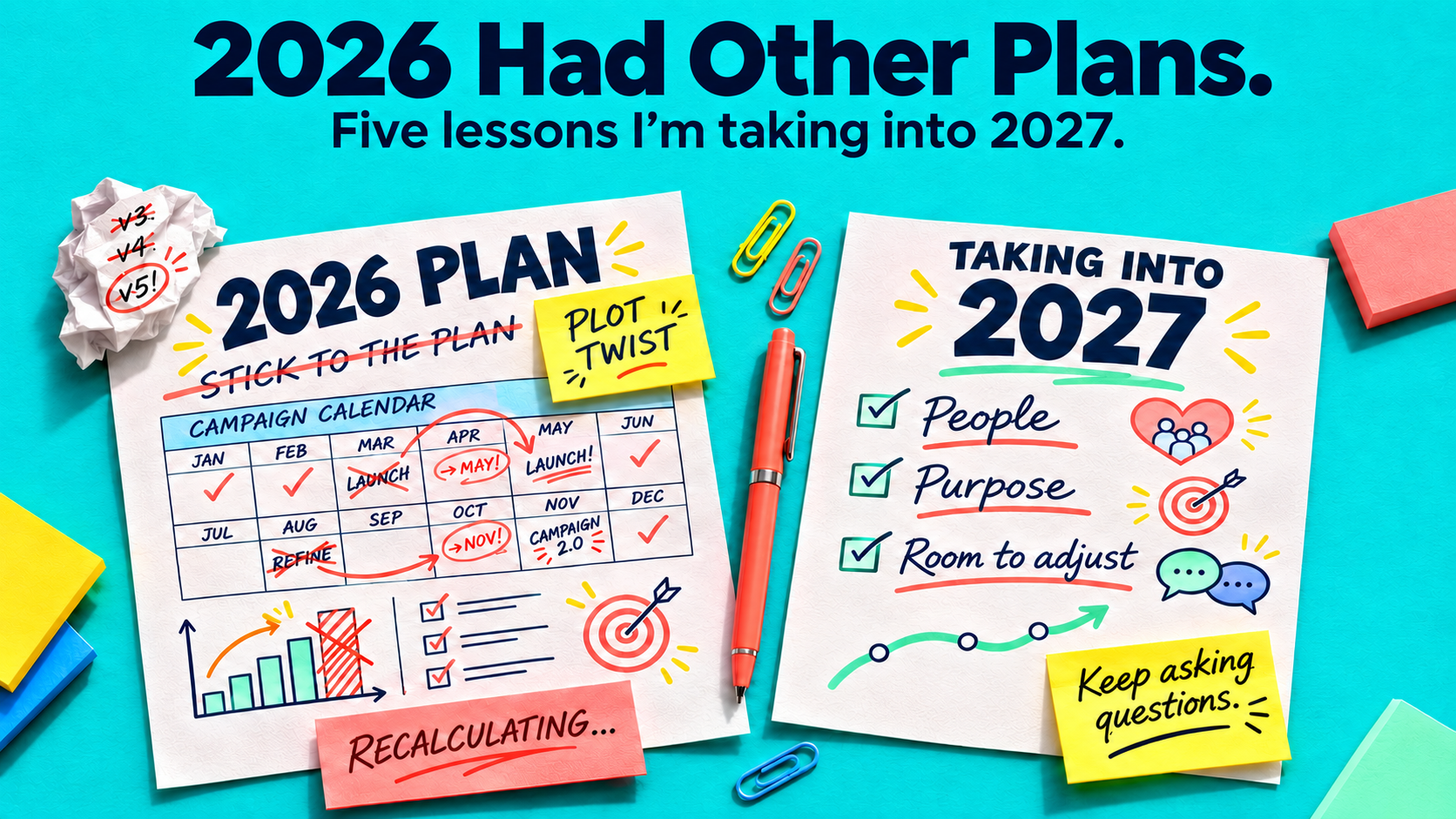
Apparently, the universe didn’t consult my 2026 plan. I’m not terribly excited about that.
I spend a lot of time helping organizations plan for what comes next. You’d think that would earn me some professional courtesy from the universe.
Apparently, there’s no reciprocal agreement. 2026 brought opportunities to do meaningful work with smart people, plenty of learning, and a few changes I hadn’t penciled into the calendar.
It also brought my third spine surgery. My previous one was only about a year and a half earlier, so I would have happily declined the repeat invitation. Recovery has required patience, which, for anyone who knows me, is a particularly irritating assignment.
Professionally, I’ve been bringing renewed energy to my strategic communications agency TCSC, reconnecting with people, and thinking carefully about where my experience can be most useful. It’s been exciting, challenging, and a reminder that having a plan doesn’t exempt you from having to make another one.
Meanwhile, marketers and communicators have been navigating our own collective plot twists. AI keeps giving us new capabilities and new questions. Organizations want clearer evidence of value. And the work still needs to get done while everyone figures out what changes next.
So, yes, I’m doing some year-end reflecting in November. I’d like to use a few of these lessons before January arrives with another ambitious list of expectations.
2026 still has a few weeks to surprise me. But it’s already given me plenty to think about, especially how we recognize progress, make decisions, protect relationships, and spend our limited time.
Here are five lessons I’m taking into 2027, and how they can help you approach marketing and communications planning with clearer priorities, room to adapt, and a better reason for the work.
I’d love to tell you that my first response to an unexpected change is calm, thoughtful reflection.
Sometimes, it’s more of an irritated internal monologue, with the reflection coming later.
Looking back gets uncomfortable because we have to revisit decisions that made sense at the time, expectations we were excited about, and things we put considerable effort into that didn’t work out as planned. It’s tempting to skip ahead to a fresh calendar and some new goals.
But what are we carrying into that calendar without examining how we’re getting there?
This year has given me reasons to ask that question a bit more intentionally. Recovery has forced me to reconsider my pace. Bringing renewed focus to TCSC has meant thinking about which opportunities to pursue, what I’ve learned from meaningful work alongside talented people, and how to put that experience to use. Reconnecting with colleagues and friends has reminded me how much I value those relationships beyond whatever happens professionally.
There’s a lot worth carrying forward, and I want to be deliberate about choosing it.
As marketers and communicators, we understand this. We wouldn’t recommend repeating a campaign simply because everyone worked hard on it. We’d look at what happened, whether it supported our objectives, and what the evidence suggests we should adjust.
That’s why building evaluation into the planning process matters. It gives us a way to learn while there’s still an opportunity to do something with the information.
Our own plans deserve that same attention. For me, that means asking three questions:
Some answers will reinforce what I’m already doing. Others will require an adjustment I’d rather avoid. It’s annoying, but useful.
That’s why I’m starting here. Before deciding what 2027 should look like, I need to understand what this year has taught me about my capacity, my priorities, and where I can contribute most.
My spine has shown very little interest in my preferred timeline, which is rude since this is the third time we’ve been through this.
I can understand the recovery instructions, follow them, and still wish things were moving faster. According to my physical therapist, Mike, wanting to be further along doesn’t count as a rehabilitation strategy.
The difficult part has been accepting that progress can be real without being particularly dramatic. Smaller improvements deserve attention, even when I’m impatient for the bigger milestone.
That’s familiar territory for marketers and communicators.
We set objectives, build a timeline, and get to work. Then we reach a checkpoint and discover that the results haven’t caught up with our expectations.
Of course, before deciding the campaign needs more time, or declaring it a failure, we need to examine what’s happening. Are customers asking more informed questions? Is the message reaching the right people? Are those people taking steps toward the action we want?
Those signals can help us understand whether the approach is gaining traction. They also need a credible connection to the objective. Three enthusiastic comments don’t automatically explain a missed sales target.
We’ve talked about giving a strategy time to work while adjusting the execution. But the challenge is knowing when to stay patient and when to make a change.
For 2027, build checkpoints into your plans. Decide what progress should look like along the way, what evidence would justify extending the timeline, and what would tell you to reconsider the approach.
And please give progress time, but set checkpoints. I’m working on that first part…enthusiastically would be an overstatement.
Sometimes, the checkpoint tells you something needs to change. Then comes the fun part—actually changing it.
Bringing renewed focus to TCSC has meant making decisions about where I want to take the business, which opportunities fit, and how to apply everything I’ve learned along the way. I’ve had the chance to work alongside talented people on meaningful challenges, and that experience gives me a stronger foundation for what comes next.
It doesn’t, unfortunately, come with a calendar invitation telling me exactly when everything will work out. I’ve checked, and it’s not there.
This year has reinforced the value of having options, and the confidence to pursue them. A backup plan becomes much more useful when you’ve maintained the skills, relationships, and resources needed to act on it.
The same applies to our marketing and communications plans. A budget changes, audience research challenges an assumption, the organization’s priorities shift, and suddenly, the approach everyone approved needs another look.
Preparing for situations your plan didn’t anticipate isn’t easy, and that preparation needs to include how you’ll make decisions when circumstances change.
Before carrying a plan into 2027, identify the assumptions it depends on. What would cause you to reconsider? What alternatives could you realistically pursue? Who needs to be involved in that decision?
You don’t need a fully developed campaign for every possible scenario. You do need enough preparation to make a purposeful choice.
Changing the plan can be the most purposeful decision you make, so give yourself permission to make it while you still have options.
“I’ll reach out when things settle down” is a lovely intention. It’s also how six months disappear.
Trust me on this!
This year has reminded me to stop waiting for that mythical opening in the calendar. Time with Lindsay and Colt matters, of course, but so does catching up with a friend, hearing how a former colleague is doing, or making time for someone finding their way into the profession.
Reconnecting with people has been one of the most rewarding parts of putting renewed energy into TCSC. I’ve enjoyed hearing what they’re working on, trading perspectives, and picking up conversations that deserved more than an occasional LinkedIn like.
And yes, some conversations are worth having without a proposal attached.
Pew’s research on where people turn for support and connection explores the role of partners, family, and friends in our support networks. Those relationships deserve attention throughout the year, including when things are going well.
Professionally, making room for people also creates opportunities to learn and contribute. A colleague can challenge an assumption you’ve stopped questioning. A student can bring a perspective you haven’t considered. You might have experience that helps someone else take their next step.
The same attention belongs in our work with audiences. A conversation with a customer or frontline employee gives us room to ask another question, hear the hesitation, and understand what a dashboard can leave unexplained.
For 2027, make connection a recurring part of your plans. Reach out to someone you miss. Offer time to someone you can support. Give the people closest to you some attention that hasn’t already been exhausted by the workday.
That might mean coffee, a phone call, or a quiet afternoon together. Find what works for you and the people involved.
AI has given me plenty to write about this year. It has also given me plenty of reasons to pause before accepting an answer.
Apparently, a confident tone and some bullet points can be very persuasive. I suppose it’s an occupational hazard for those of us who enjoy a well-organized recommendation.
Exploring how easily we can outsource our judgment along with the task has reinforced something I’m carrying into 2027: experience should help us ask better questions.
That includes questions about our own thinking. Am I accepting this recommendation because the evidence supports it, or because it agrees with what I already wanted to do?
For marketers and communicators, the consequences extend beyond an inaccurate sentence. An unchecked assumption about an audience can shape the messaging, the campaign, and the advice we give leadership.
So, before approving AI-assisted work, ask what supports the recommendation. Check the original sources. Talk to someone who understands the audience or the situation. Consider what might happen if the advice is wrong.
Then ask yourself: could I explain and defend this without reopening the chat?
That’s a useful standard whether you’ve been doing this for two years or 20 years. Confidence in your experience should leave room to learn something that changes your mind.
For 2027, put that scrutiny into the workflow and budget time for it.
Between recovery and putting renewed energy into TCSC, I’ve had to think carefully about where my time and energy go.
I can fill a day quite efficiently. Whether I filled it with the right things is a more irritating question.
Writing, recording videos, reconnecting with people, developing proposals…all of it takes time. Each deserves a clear reason for being there. That might be helping someone understand a challenge, strengthening a relationship, or exploring an opportunity that fits.
Our marketing and communications plans deserve the same discipline.
Before adding another channel, campaign, or weekly deliverable, ask what it contributes. What should the audience understand or do? How does this effort support that outcome? What needs to happen elsewhere in the organization for it to work?
That last question is where integration becomes practical. Marketing can promote a promise, communications can help make the evidence behind it accessible, and operations and customer-facing teams need to deliver the experience. Planning those responsibilities together gives the campaign a stronger foundation.
For 2027, review your recurring activities against your priorities. Keep what contributes, improve what has potential, and stop what you can no longer justify. Then make sure the people involved understand how their work connects.
Every activity spends something: time, money, energy, or attention. You need to know what you expect in return.
I would appreciate fewer plot twists, and I’m comfortable putting that request in writing.
But I’m heading into 2027 knowing that some plans will change, some progress will take longer than I’d like, and some opportunities will arrive looking nothing like what I expected.
There’s plenty from this year I’m grateful to carry forward: meaningful work, generous people, new perspectives, and a clearer sense of where I want to put my energy.
The challenge is making those lessons visible in my decisions.
For me, that means planning around my actual capacity, leaving room to adjust, making time for Lindsay and Colt, and staying connected with people I value. Professionally, it means asking better questions and being more deliberate about the work I take on and recommend.
For fellow marketers and communicators, there’s a useful exercise here before the next planning meeting: choose one thing this year taught you, then identify where that lesson belongs in your plan.
Does it change a timeline? A budget? Who needs to be involved? Does it mean taking something off the list?
Give it a specific action and a place on the calendar. Otherwise, January gets a fresh set of goals built around habits we’ve never reconsidered.
I’m not asking 2027 to behave. I am asking myself to use what 2026 taught me.
Oh, and the universe can expect a follow-up, and perhaps a strongly worded letter.